
Zactonz Lite
v1.0.0A featherweight block theme for publishers who care about page weight. It adds no stylesheet request of its own and downloads no web font by default.
Zactonz Lite is a block theme for WordPress built around one measurable goal: adding as little as possible to the page. It is made for sites where the words are the point, such as a blog, a writer's site, a newsletter archive or a small company site.
Most themes compete on how much they include. This one competes on how little it costs a visitor to load. Everything it leaves out is something a browser does not have to download, parse or wait for.
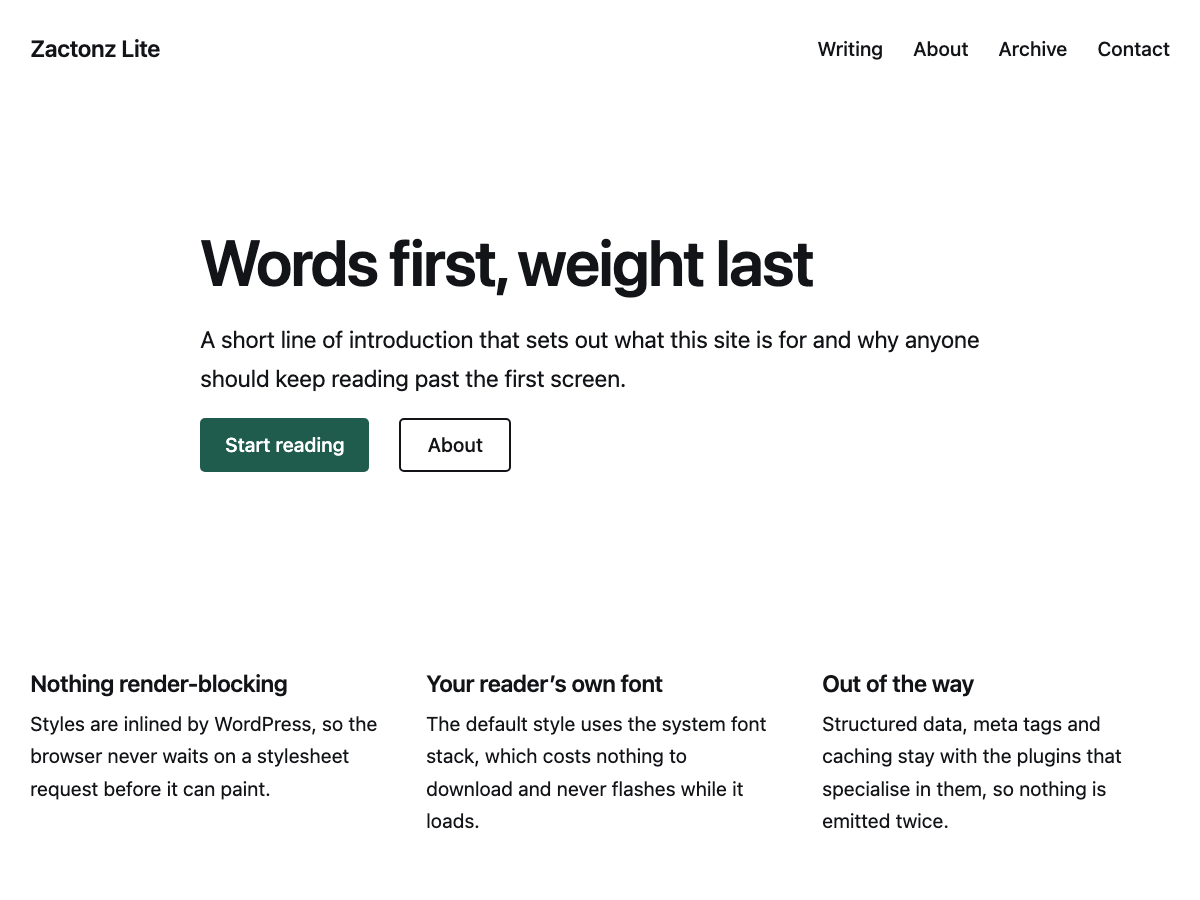
Who it is for#
- Writers and publishers who want a clean, readable page and nothing in the way of it.
- Site owners who care about speed and would rather start light than strip a heavy theme down.
- Developers who want a small, readable block theme to build on, with every non-obvious decision documented and switchable by a filter.
It is not the right choice for a site assembled in a page builder, or for a shop that needs dedicated WooCommerce templates.
How it stays light#
Four decisions account for most of the difference between this theme and a typical one.
Its styles are inlined, not requested#
A theme normally adds at least one stylesheet the browser must fetch before it can show anything. Zactonz Lite registers its styles so that WordPress writes them into the page itself. There is no extra request, and nothing from the theme blocks the first paint.
It uses the font your reader already has#
The default style uses the system font: San Francisco on Apple devices, Segoe UI on Windows, Roboto on Android. Nothing is downloaded, text appears at once, and it never flashes or shifts as a web font arrives. A font file is fetched only if you choose the Editorial style, which sets headings in a serif bundled with the theme and served from your own site.
Its menu needs no JavaScript#
Most themes turn the menu into a button on small screens, which needs a script and a large stylesheet to open it. Here the menu simply wraps onto more rows. It works with JavaScript turned off, and search engines can follow every link in it. The result is that the theme adds no JavaScript of its own to the front page.
It replaces the largest stylesheet WordPress adds#
WordPress's own navigation stylesheet is about 20 KB, most of it for the overlay and submenu variants this theme does not use. The theme supplies one of under 2 KB in its place. One line of code restores the original if you need it.
Measured#
The figures below come from one install, with the same content and the same method for every theme, on WordPress 7.1.2. Bytes are uncompressed and count the page plus every stylesheet, script and font it loads. Images are left out because they are content, and identical whichever theme is active.
Home page
| Theme | Total bytes | Stylesheet requests | Elements on the page |
|---|---|---|---|
| Zactonz Lite | 78,911 | 0 | 134 |
| GeneratePress 3.6.1 | 126,757 | 1 | 392 |
| Neve 4.2.15 | 134,576 | 1 | 313 |
| Twenty Twenty-Five 1.5 | 280,916 | 2 | 1,083 |
A post with 19 comments
| Theme | Total bytes | Stylesheet requests | Elements on the page |
|---|---|---|---|
| Zactonz Lite | 102,648 | 0 | 397 |
| GeneratePress 3.6.1 | 133,917 | 2 | 544 |
| Neve 4.2.15 | 149,959 | 1 | 545 |
| Twenty Twenty-Five 1.5 | 186,708 | 1 | 521 |
A post with five images
| Theme | Total bytes | Stylesheet requests | Elements on the page |
|---|---|---|---|
| Zactonz Lite | 100,666 | 0 | 210 |
| GeneratePress 3.6.1 | 135,504 | 2 | 355 |
| Neve 4.2.15 | 151,599 | 1 | 353 |
| Twenty Twenty-Five 1.5 | 182,717 | 1 | 324 |
Every total includes about 25.7 KB of emoji script that WordPress itself adds to every page. A theme in the WordPress.org directory is not allowed to remove it, so all four themes carry the same amount.
What these numbers do not say#
They are lab measurements of what a theme contributes on one controlled install. They say nothing about how a real site scores for real visitors, or about search rankings. Those depend on hosting, images, content and plugins, and no theme can promise them.
A theme's share of a page also shrinks as a site adds plugins. With one plugin active that loads jQuery and a script of its own, the same home page was 21% lighter than GeneratePress rather than 38%. The theme still helps, but it is one part of the page.
Four styles#
The theme comes in four looks. Switching between them takes one click in the Site Editor and changes nothing about the weight, except that Editorial fetches one small font file.
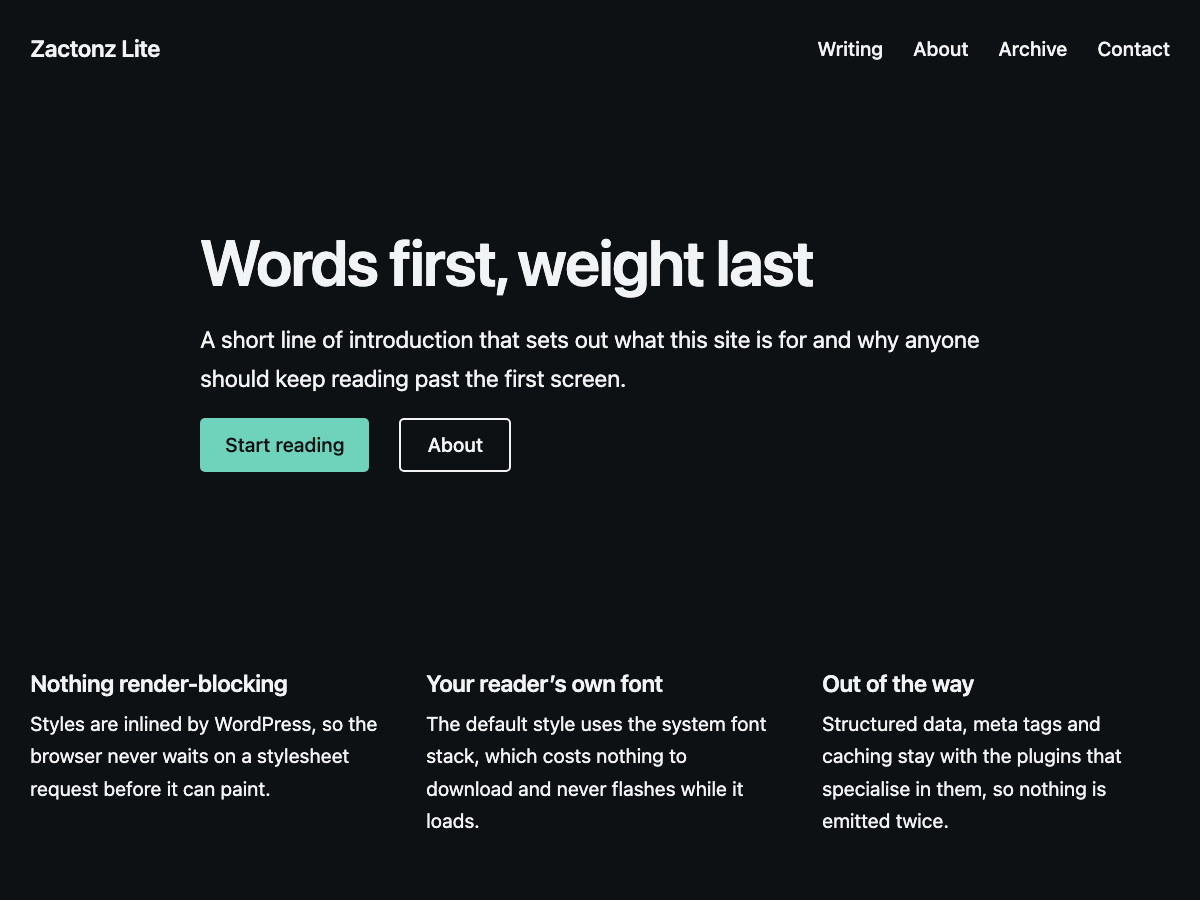
Dark: a dark ground with a light green accent.
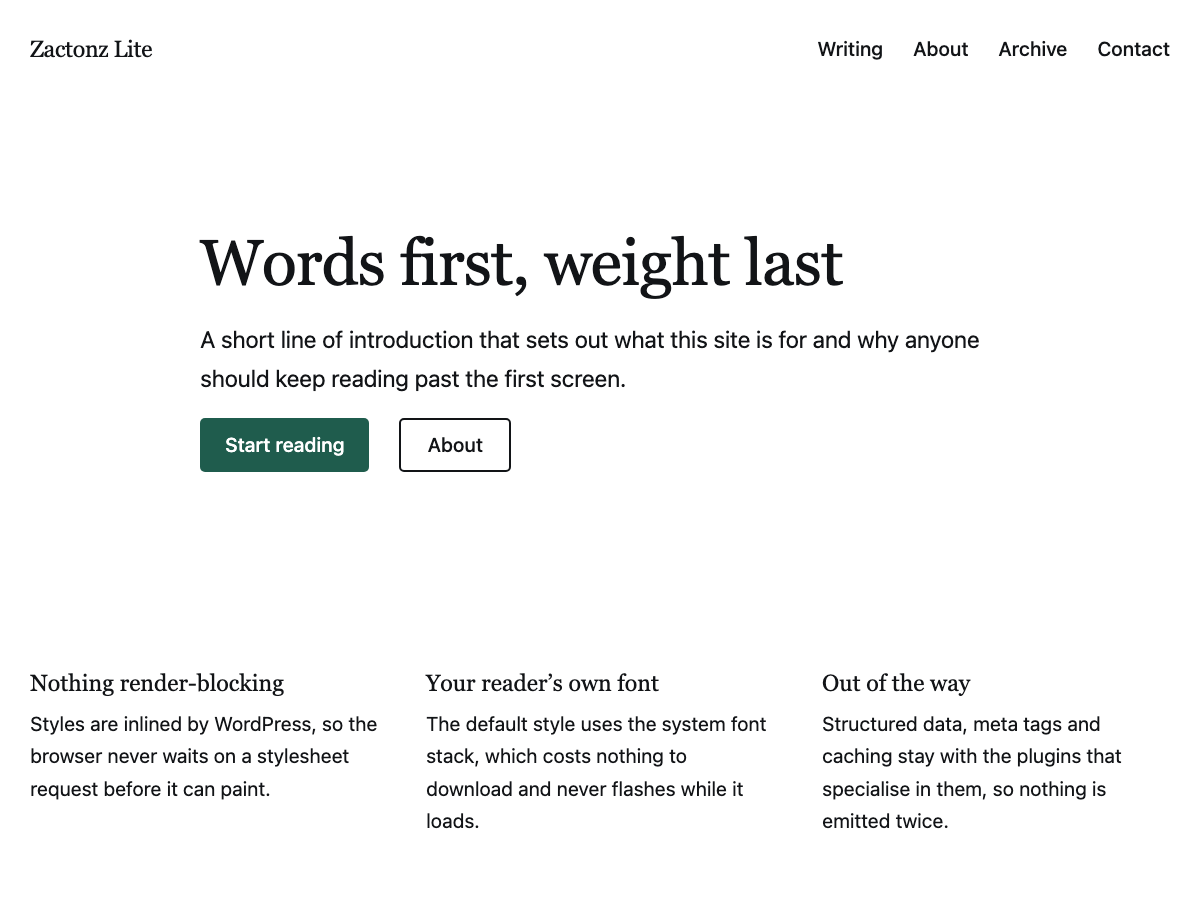
Editorial: headings in Instrument Serif.
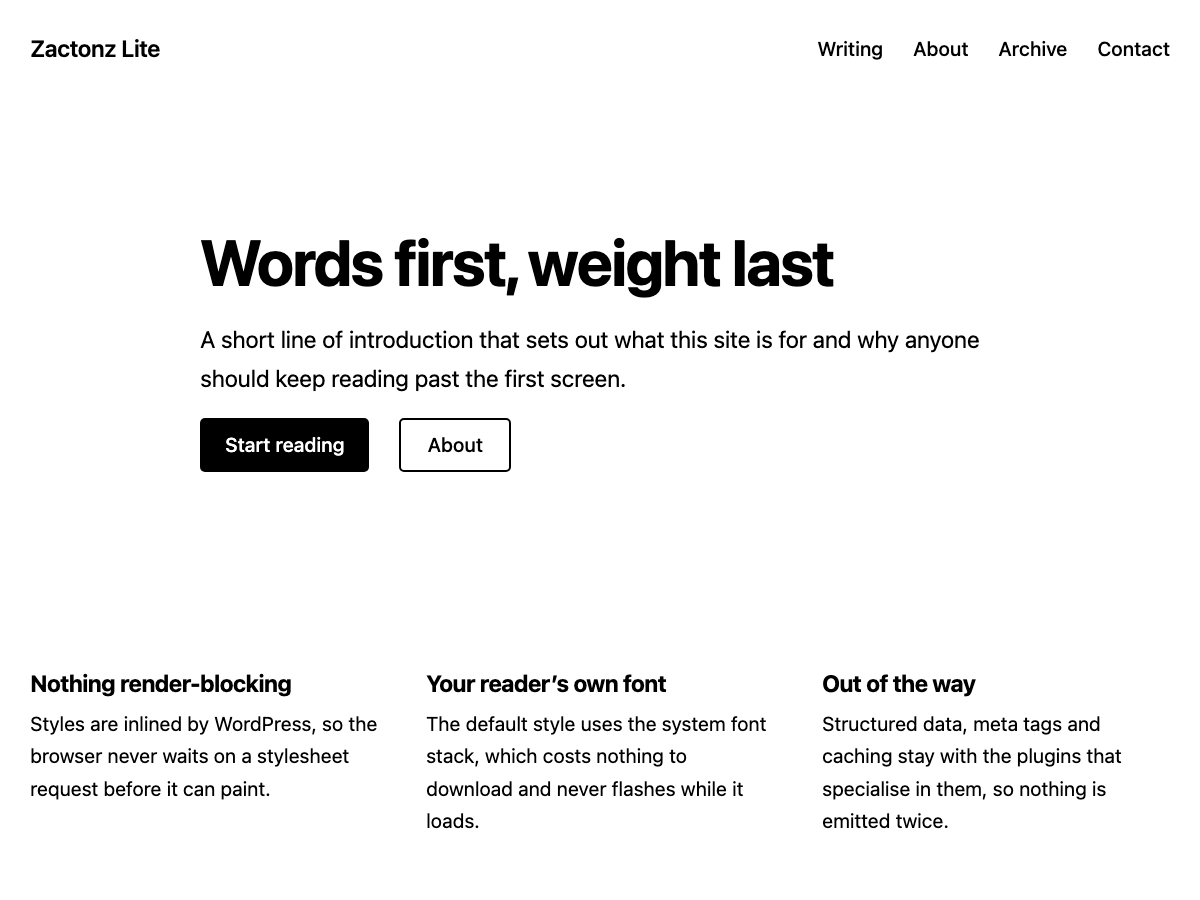
Ink: pure black on white with heavier headings.
Accessible by construction#
- One H1 on every view, and no skipped heading levels.
- Named landmarks for the header, navigation, main content and footer, and a skip link to the content.
- A visible focus outline on every link and button.
- Text contrast of at least 6:1 in every palette, well above the 4.5:1 that WCAG AA asks for.
- An automated accessibility scan with axe found no violations on the home page, a single post, the search results and the 404 page, in the default and dark styles.
An automated scan cannot prove a site accessible. The content you add matters as much as the theme.
Faster movement between pages#
On WordPress 6.8 and newer, the theme asks the browser to prepare a link's page when a visitor is about to follow it, so moving around the site feels close to instant. It steps back to WordPress's cautious default when WooCommerce or Easy Digital Downloads is active, and never applies to cart, checkout or account pages. This speeds up navigation within the site, not the first page load.
Friendly to caches#
A page cache or a CDN can store the theme's output as it is. The theme sets no cookie, starts no session, puts no security token in the page and shows dates as dates, so a cached page never displays a stale "2 hours ago".
What it leaves to plugins#
Meta descriptions, Open Graph tags, structured data, sitemaps and caching are not part of the theme. They belong to the plugins that specialise in them, and a theme that outputs them as well collides with whichever plugin a site uses. WordPress.org also asks themes to stay out of that territory, which is why there is no settings page either: everything is in the Site Editor.
What is in the box#
- Templates for the blog home, single posts, pages, archives, search results and the 404 page, plus a wide page template.
- A header and a footer template part.
- Patterns for a hero, three feature columns, an image beside text, a call to action and a posts list.
- The Dark, Editorial and Ink styles, besides the default.
- Licensed under the GPL, version 2 or later. The bundled font is under the SIL Open Font License.